Dimension framework for hives

 Loading...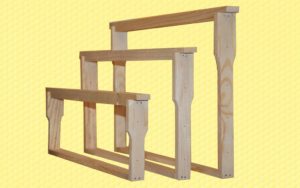
What size are the frames of hives
Frames for beehives: sizes for different.
Dimension framework for hives, as well as their basic shape and dimensions greatly affect the life of bees in the nest, as well as the process of extracting honey beekeeper.
Not long ago, people in search of honey smoked using smoke the bees out of their homes in order, to take them taken during medosbora.
But eventually found a more humane method – and taming Breeding bees at home.
For this, naturally, hives were made and the main part of bee houses – framework.
What effect sizes beyond?
Despite the simplicity of the design: Only 4 wooden slats, Frames for beehives are an important part of a home, to which production should be approached with the utmost seriousness.
The proper size, as well as materials will depend not only easy maintenance, replacement, pumping honey, but the performance of insects.
If you go wrong in a Cheating, then your frame would be inappropriate for the hive.
History of the size of the loop design
When originated beekeeping, the question arose, should look like a beehive frame sizes and it should have.

Piotr Prokopovich
The first idea was suggested unification size almost immediately, as soon as P.I.Prokopovycha invented a frame beehive.
But, despite changes, This theory was implemented only in 1918 year, when a congress of beekeepers in Kiev, USSR.
V.Yu.Shymanskyy, known in the territory of the former Soviet Union beekeeper, this gathering suggested that, that to reduce the cost of materials and supplies equipment, and simplify the life and work of beekeepers, should adhere to certain standards in the manufacture of frames for beehives.
As an industrial scale, and in independent production.
He also claimed, that such progress in beekeeping will only serve to benefit, as well as bring up some of the world practice the breeding of bees.
Despite the fact, that since Congress passed a lot of time, Frames for beehives have almost the same size, which were approved by the Congress of Beekeepers.
In the same 1918 was the famous congress adopted four options framework, which are widely used and now:
- by type Dadant-Blatt (43,5 on 30 cm);
- Langstrot-Ruta (43,5 on 23 cm);
- Shop napivramky (has a height of only half of the total size, ie 43,5 on 14,5 cm);
- Ukrainian border (The same paranasal-Blatt, only upside).
Dimension framework
The above frame dimensions remain the same for nearly 100 years, whether, They made handicraft or industrial equipment.
When parameters are set automatically establishes the right manufacturer size wax So, to not have to trim, cut or bend the edge.
In practice, beekeepers can apply various frame designs on, in his own pull wire, strengthen Wax, etc..
But one thing remains unchanged – external frame size will always limit the nest, and the factor, Wax that make only certain parameters.
That's why parts of the frame, ie wooden slats, will have certain default settings, and whereby the entire structure will be made.
Some people may ask: What guided beekeeper in the manufacture of frames and what is strictly specific numerical values?
It's simple – Most settings are automatically driven by opportunities hive, which is under the frame, and biological features of bees.
Example, the width of the upper rail, and the two sides set at around 2,5 cm – This is because, then the bees are building environment cell exactly the same width.
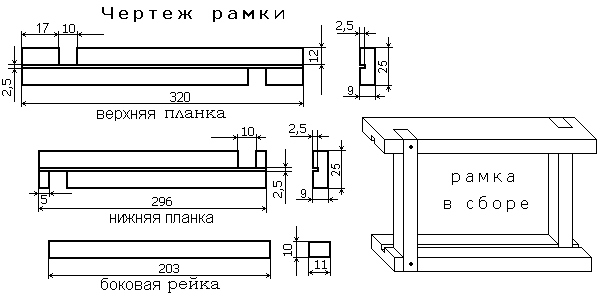
Drawing frames for beehives
The dimensions of the upper rail
The top rail should be 47 cm long. If not sustain this paragraph and make it more, it snaps into the grooves design.
Perhaps only a slight decrease numerical value, but no more than a couple of millimeters.
Otherwise arching framework can fall out of it destined for shoulder pocket.
As for the thickness of the structural elements, that beekeepers do not limit yourself and can create a frame with this option on 0,1 cm 2,5 cm.
It all depends on the type of hive, and the personal preferences of each beekeeper.
Speaking of accepted standards, then the aforementioned reference thickness Congress recognized 1,8 cm.
When the practice was used is a numeric value, many experienced beekeepers concluded, that this little (especially Dadana-Blatta) and began to use thickness 2,5 cm.
Today, some may apply and 1,5 cm, that in their version would be quite acceptable value.
Moreover, is thought, the smaller is the thickness, the more space left in the hive for the completion of the WTO.
Lowering this setting 10 within, beekeeper can get to 1,5 kg of excess honey, what, agree, very good.
Read: How to prepare the bees to winter on the street.
The side rails
At the same Congress discussed all sizes framework, to be applied in beekeeping.
The side rails also found their reference values. It includes the following options, the thickness, width and height of the frame.
Height is determined by the vertical length from top to bottom rail.
It is for each hive has its own. Width generally recognized for all – 2,5 cm.
Some beekeepers have expressed approval for the benefit of several hybrid frame size – with lateral strip of separator Hoffman (width 3,75 cm).
Experienced beekeepers have expressed some ambiguous opinion about the use of hybrid and standard width.
Those frames, which will go to collect honey, better to do without any dividers.
Delimited only suitable for housing rasplodnoho.
Frames with separator have some disadvantages:
- pressed more bees during the review;
- to get badly from the hive, as much glued together by propolis;
- can not adjust the width of the streets in the nest;
- some difficulties in manufacturing.
Read more: brood bees, and what to do, if not
Most beekeepers consider more appropriate to use one sample frame – without separator.
The optimum thickness of the strips – 1 cm. If you take the less important, then the tension of the wire can be seen the deformation of the rails.
Only the frame of the type applicable option Ruta 0,8 cm and it does not prove fatal error, leading to a trough.
Lower rack
Its numerical values may differ depending on, prefers every beekeeper.
We can only give some recommendations on its size.
- If the frame is made to brood, the recommended width – 1,5 – 2,5 cm, thickness – from 1 cm 0,8 cm (relevant parameters width: more than it, the less thickness).
- The advantage for honey frames given width in 1,5 cm, because it simplifies the movement of bees in the hive, especially during hibernation.
- Strengthen the lower bar should not butt, and a spacer, that is limiting its side rails. This attachment will allow a firm foothold and can not fall off in case, when there is a strong tension wire.
So, the length of the lower rail is strictly individual (depends on the thickness and width limit its elements).
Video