Keeping bees

 Loading...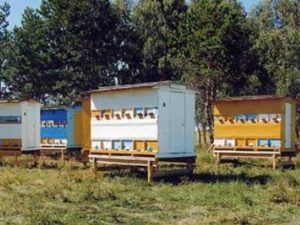
Methods of keeping bees in the hive
Keeping bees: how, methods, requirements, video.
In ancient times, the Slavs were engaged in production of honey and wax in the dense forests, are commonly inhabited by wild bees.
Over time, people began keeping bees in practice carved hollows in trees – bortyah, This simple technique continued to beekeeping 18 century.
This maintenance of bee colonies was that, originally prepared board, then lured swarms.
Spring board slightly vychyschaly, After collecting honey vidbyravsya, a nest protected wild animals.
Next, too primitive stage in keeping bees – This application not folding beehives in the apiary.
When this method is used riyebiyna system bee. Roy sulfur vykuryuyetsya, then vidbyravsya honey.
In the apiary with this method remained weak, unproductive bees, which almost swarmed.
A huge contribution to the improvement of equipment beekeeping beekeeper introduced researcher AP. AND. Prokopovich.
Using their research into practice, He developed a theory, how to keep bees in the hive collapsible framework.
In this bee keeping much attention to the fight against disease, efficient use of feed, control and accounting on an apiary.
Ways of keeping bees
Keeping bees varies by the type used in beekeeping hives.
From type hives, its design and development of the system depends bee colonies, their performance, way service beekeeper and honey combs selection.
Products chosen hive directly related to the natural conditions of the region, medosbora and breed bees.
Keeping bees in hives Multiple
Nest disassembled frames horizontally and vertically buildings.
Winter uses two buildings, spring bees weak, they leave a building, and summer, during medosbora, bees put four cases.
Exhibiting a beehive beehouse, remove the lower body. During medosbora expanding slot, the second building put at first, the second body fit two frame Wax.
- The first expansion slot achieves bezroyovoho keeping bees. Rearrange the lower housing on the upper promotes more egg-laying queen, as it tries to go to a warm place.
- The second extension – third body placed between two buildings with brood. Cases with swap. Lower body of brood placed on top, average body frame are Wax, are placed between honeycombs. In the third case malozapolnenni honey cell or cells with ambrosia located edge.
- The third expansion slot makes, adding housing construction during the productive medosbora. Bees are engaged in rebuilding cells in the body and forget swarming.
- The fourth expansion slot while exercising, when the uterus highly prolific, many forms of brood combs, by adding a fourth building for honey. Its cast top. The two lower hull separated from the upper separate bars, to restrict the entry of a large scar in the upper body.
At the end of the period medosbora bees are removed from the upper body, of which pump out the honey. Bees leave one or two lower hull.
This deduction is ideal for bees, they tend to place the honey in the hive of the top buildings.
Keeping bees in the hive-lounger
lounger Beehive located horizontally, capacity of 16 to 20 framework, sometimes 24.
Expanding socket honeycombs, and during medosbora frame attached Wax.
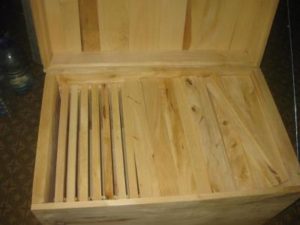
lounger Beehive
Frames of brood placed in the center of the nest, increasing the number of 8 to 12.
Spring Nest extend honeycombs, if the family strong, then add the slot on the edges of two cell.
During medosbora cell instead put the frame with Wax.
To prevent the swarm condition jack expand once.
Uterus with five separate honeycombs using separate grilles.
The volume of collected honey, so as to collect the bees involved – educators brood.
Selection of cells is carried out in proportion, honey matures.
Keeping bees in the hive dvuhkorpusnyh
The principle of keeping bees in the hive dvuhkorpusnom like to work with sunbeds. The work is done on separate framework. The family takes 12 cell.
The second building put on top, he placed 4 hundredth of the lower shell, brood on three framework and covering hundreds of ambrosia.
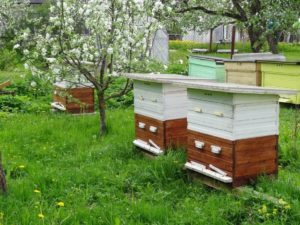
Dvuhkorpusnyy hive
The lower body put a new coating hundred.
The upper body produce prolific forming layers of the uterus.
There is rapid development layering.
From the basic family take hundreds of brood, thereby increasing leads.
Then vidvodok and basic family combine.
In July, lower case concerns grill, which separates from the uterus brood.
The upper body layering creates a family of cells with honey, cells of the upper body then exported to pump. In the winter the family remains in the lower body.
Warning! Multiple hives require less time spent on maintenance, than beds or double-hulled hives, because in these cases the work produced for each frame separately, and double-hulled hives with large mass, and beekeepers alone can not cope with them.
But the work of Multiple hive mean a highly qualified beekeeper.
Cassette keeping bees
The advantages of this method of keeping bees:
- In these halls are bees all year round. Sections are composed of compartments with drawers of cassettes are arranged in frames. Each cassette is pushing to work independently of the other, which allows work, without bothering other family.
- Cassette allows maintenance beekeeper do winter without beehouse, such as in winter the temperature is maintained hive +20 ° C.
- In winter, the bees are placed in the lower cassettes, In this state bdzholosim'yi they must be checked at -50 ° C. In April, manufacturing floor cleaning, while the lower cassette removed, bees transferred to new tapes. If the place for holding family had, it is made adding new tapes. The family is divided into two parts: queen with brood and bees working hours. Rozplodna part is placed in a separate tape. The development of both sides of the family held separately. Prior to the main medosbora practiced Family Reunion, allowing for the maintenance of bees bezroyovoe.
- Bdzholopavilyon takes up less space in the apiary, making it easy to carry keeping bees in the country.
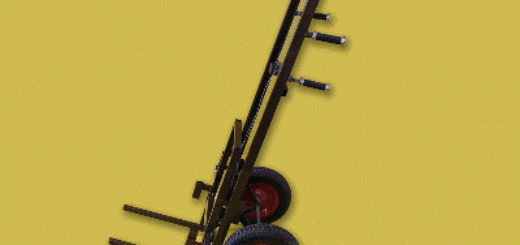
- It is easier to take out a place for migrations, Pavilion as cassette can be placed on the coupling on wheels, which gives it great mobility.
- In the cassette hive easier to maintain health standards bee keeping. Each cartridge is processed from mite and from bacterial diseases. In this sense thanks to the support required temperature and ventilation in the nest, and heat-treated thin wall sections and cover them with wax comes hnyltsevyh avoid diseases.
- The design of the cassette hive is very convenient. Having lifting semicircular top visor allows for extra ventilation in hot weather.
- Performance bee colonies, contained in this hive, above a half to two times thanks in part to the mobility of the hive.
Non-contact keeping bees
Going back to the origins of beekeeping, In Shapkin. F. developed and brought into operation 1990 , the hive-deck.
Technology content in this hive-based application framework uzkovysokoyi.
Keeping the family in such a hive resembles life of bees in nature and holes in the sides.
Beehive Shapkin consists of five buildings, in which there are lines for wax, insulated roof and combined bottom.
Keeping bees in NL-2 has many advantages over other hives:
- As with dependent families in the deck, reduced human contact and bees.
- It meets the biological life of bee colonies.
- In this hive swarming is controlled by the beekeeper.
- When operating NL can use standard frame.
- Frames housing during the winter can be placed on a cold and warm snow.
- You may work individually with shells.
- NL well insulated.
- NL housings can be used as stores any standard hive.
- Very useful when nomadic work.
- Apiary heals without drugs.
In theory Shapkin. F., contained in his book "Non-contact beekeeping", and its practical advice on keeping bees contactless supported by many enthusiastic beekeepers.
created hives, Similar NL, enabling even people with disabilities engage in beekeeping.
The principle of such hives based on technology keeping bees in the hollow, the result is a strong family without diseases and parasites, very hard-working and self-regulate their activities.
Keeping bees in warm skid
In the hollow logs and man almost does not interfere in the life of bees, They own nest.
Strong bee honeycombs rebuilt skidding on ice (cell perpendicular to the notch), and weak – the warm (parallel to the notch).
The method of beekeeping the warm snow used in sunbeds in areas with a long, harsh winter.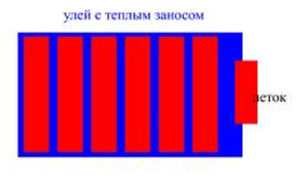
For the first time compared the principles of keeping bees in the hive with cold and warm drift beekeeper in Nestervodskyy. BUT.
According to his research, during the winter in the hive on warm snow killed far fewer bees, hives than in cold drift.
In the hot season, vice versa, in the nests of bees cold drift was more comfortable.
These nests better ventilated, but as we know, bee brood are closer to the notch for better air, because the larvae developed better.
In spring and autumn, bees nests comfortable in cold drift, and in winter it is necessary to use the contents of the warm snow.
This finding is in Nestervodskoho. BUT. the method used in the creation of beehives, where the location of the cell varies depending on the season.
Families, which used to rotate frames 90 °, better developed, were more productive, Unlike those, are placed in hives just to drift ice.
Read: The system "Nikot" (Nicot) to remove a uterus: video.
Requirements for keeping bees
Ministry of Agriculture approved the document "Rules of keeping honey bees", which clearly defined the basic requirements, used for keeping bee colonies.
The document clearly identified, how should contain bees for quality of honey and other bee products.
This may read The Law of Ukraine "On Beekeeping".
Basic requirements – is to maintain order in the hive, disinfection equipment, prevention and treatment of diseases of bees.